
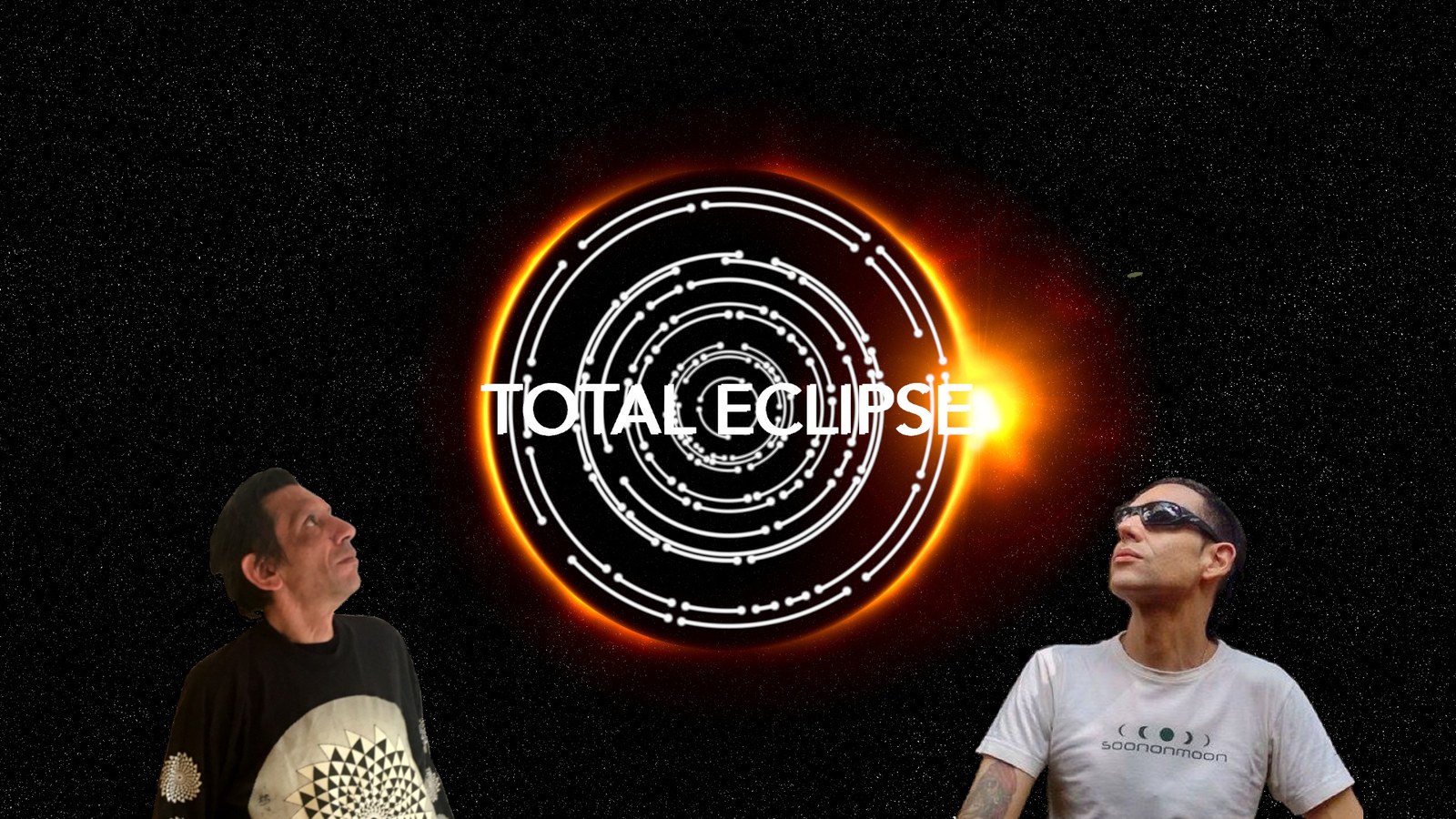
The story behind Total Eclipse
Total Eclipse belongs to the first generation of European projects that turned the early Goa party sound into a distinct studio form. Stéphane Holweck, Serge Souque and Loïc Vanpoucke formed the project in France around 1992, with Holweck bringing experience from earlier electronic work and from his involvement with Juno Reactor. Their music developed at the same moment that the loose category of “Goa music” was becoming an identifiable international genre. The debut album Delta Aquarids appeared in 1995, followed by Violent Relaxation in 1996 and Access Denied in 1999. Those records show why Total Eclipse never fit perfectly into a single formula.
The project could be melodic and recognizably Goa, but it also drew from techno, industrial electronics, breaks and experimental production. Violent Relaxation in particular became a major reference point for listeners who wanted psychedelic trance that was atmospheric and detailed without relying only on bright melodies. After 2005, Souque and Vanpoucke moved toward other projects and Holweck continued Total Eclipse alone. That solo phase preserved the identity through a period when many first-wave Goa acts had become inactive. A new chapter began in 2019 when Holweck merged the 0101 connection into Total Eclipse and Marios Trivyzas became part of the project.
Later releases including Into The New Room and Cyclops document this modern duo period. The present-day Total Eclipse therefore contains several distinct historical phases: the classic French trio, Holweck’s solo continuation, and the later Holweck/Trivyzas partnership. Treating all three as one unchanged lineup obscures the project’s real development. What has remained consistent is an appetite for psychedelic music that reaches beyond strict genre boundaries.
Origins of Total Eclipse
Total Eclipse formed in France around 1992 with Stéphane Holweck, Serge Souque and Loïc Vanpoucke. Holweck had already worked in experimental electronic contexts, including an early connection with Juno Reactor, and the trio entered Psytrance before the style had fully separated from the broader Goa and trance underground.
The early years
Delta Aquarids (1995) established Total Eclipse during the first international Goa album boom. Violent Relaxation (1996) deepened the project’s reputation with a darker and more spacious psychedelic sound, while Access Denied (1999) showed a willingness to mix trance with wider electronic influences instead of simply repeat the original formula.
How the career developed
The original trio gradually dissolved after the classic period. By the mid-2000s Holweck was carrying Total Eclipse as a solo project. In 2019 a new phase began when Marios Trivyzas, connected through 0101, became part of the current lineup. Into The New Room (2021), Cyclops (2022) and later BMSS-era work belong to this renewed partnership.
Total Eclipse sound
Total Eclipse spans Goa Trance, Psytrance and a broader experimental electronic language. The classic records often use deeper atmospheres, unusual percussion and darker textures than the brightest melodic Goa of the period. Later material keeps the psychedelic core while drawing from newer production methods and the individual backgrounds of Holweck and Trivyzas.
Place in psytrance history
Total Eclipse were one of the formative French contributions to the international Goa Trance explosion of the 1990s. Total Eclipse showed how Goa/Psytrance could absorb techno, breaks and experimental studio ideas without losing its psychedelic character. The project’s survival through multiple lineup phases also makes it a direct link between the original scene and current performance culture.
Connections and influence
Blue Room Released is central to the classic album period. Juno Reactor is relevant to Holweck’s earlier network, while 0101 explains the later connection with Marios Trivyzas. Current membership should be presented separately from the founding trio.
Total Eclipse today
Active as Stéphane Holweck and Marios Trivyzas. BMSS presents that duo as the current Total Eclipse lineup, with releases continuing into the mid-2020s.
How the sound changed over time
Selected releases in the archive
Related projects and collaborations
Artists with overlapping styles
Etnica
Italian Goa Trance pioneers whose original Milan quartet helped define the dense, melodic and futuristic psychedelic sound of the mid-1990s.
Koxbox
Danish psychedelic-trance project founded by Frank Madsen and Peter Candy, later involving Ian Ion and ultimately continued by Madsen, with a major role in the transition from early trance into Psytrance.
The Infinity Project
Early British electronic project centred on Raja Ram and Graham Wood, foundational to the emergence of UK Goa Trance and the creation of TIP Records.
X-Dream
German duo Marcus Maichel and Jan Müller, pioneers of a harder, stripped and techno-influenced direction that helped reshape Psytrance at the end of the 1990s.
Alien Project
Israeli producer Ari Linker’s long-running psychedelic-trance project, active since the 1990s and closely tied to the international full-on movement of the early 2000s.
California Sunshine
Israeli Goa Trance project created by DJ Miko and Har-El Prussky, whose classic late-1990s catalogue later split into separate branches using the same name.