
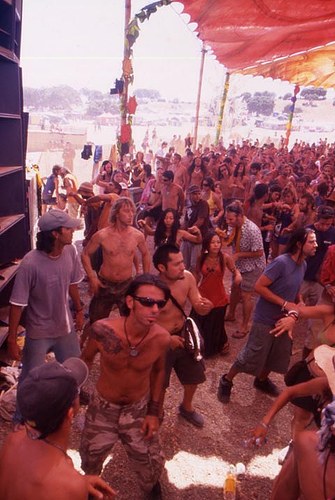
Psytrance festivals are more than oversized club nights. Academic histories describe the festival as one of the most important public expressions of the global psytrance movement: a temporary environment where music, travel, visual culture and scene networks are brought together for several days.
From traveller gatherings to international festivals
The festival lineage is connected to the same transnational movement that shaped Goa Trance. As the recorded music spread during the 1990s, audiences no longer needed direct experience of Goa to participate in the culture. Regional organisers built their own parties and festivals, while touring DJs, producers and travellers linked those events into an international circuit.
Festivals such as Boom, Ozora, Universo Paralello, Antaris and many smaller gatherings became meeting points for scenes that otherwise operate locally. This does not make every festival culturally identical. Some emphasise particular subgenres, some are highly commercial, some foreground ecological or spiritual programmes, and others concentrate much more narrowly on music and camping.
Building a temporary world
Outdoor setting is important to many psytrance festivals. Sound systems, lighting, visual art, decoration and landscape can combine to make a familiar field, forest or lakeside location feel temporarily reconfigured. The dancefloor may be designed as an immersive environment instead of simply a stage facing an audience.
That environment includes practical infrastructure as well as aesthetics: camping, food, sanitation, medical support, transport, shade and welfare systems all shape the experience. At large contemporary events the cultural programme can extend far beyond the main floor.
Beyond the lineup
Boom Festival provides a established example of the multidisciplinary model. Its current programme includes large-scale art and installations, multiple music areas, talks and educational spaces, meditation and movement practices, therapies, world music, land art and community-oriented activities. Academic studies of Boom have similarly treated the Dance Temple and educational or contemplative areas as different but connected parts of one visionary-arts festival environment.
That model has influenced how many people imagine a “psychedelic festival”, but it should not be imposed on every event. A smaller festival can be culturally significant without reproducing Boom’s scale or ideology.
Ritual, liminality and belonging
Researchers often use ideas such as liminality, ritual, carnival and temporary community to analyse festivals. These concepts describe the feeling of stepping outside ordinary routines and entering a space with different rhythms, social expectations and visual cues. Participants themselves may frame the same experience as spiritual transformation, holiday, reunion, hedonism, musical pilgrimage or simple fun.
The important point is that festival meaning is negotiated rather than automatic. Claims of unity and transformation can coexist with practical tensions around money, access, safety, environmental impact, local communities and cultural representation.
Festivals as scene infrastructure
Festivals also have a less romantic but equally important function: they are infrastructure for the music. Artists meet labels and promoters, local audiences encounter unfamiliar styles, decorators and stage crews circulate between events, and friendships become international networks. A successful festival can strengthen a regional scene long after the temporary site has closed.
Use the festival archive to compare different histories instead of assuming there is one standard model. For the visual side of these environments, continue with Psychedelic Art and Stage Design.