
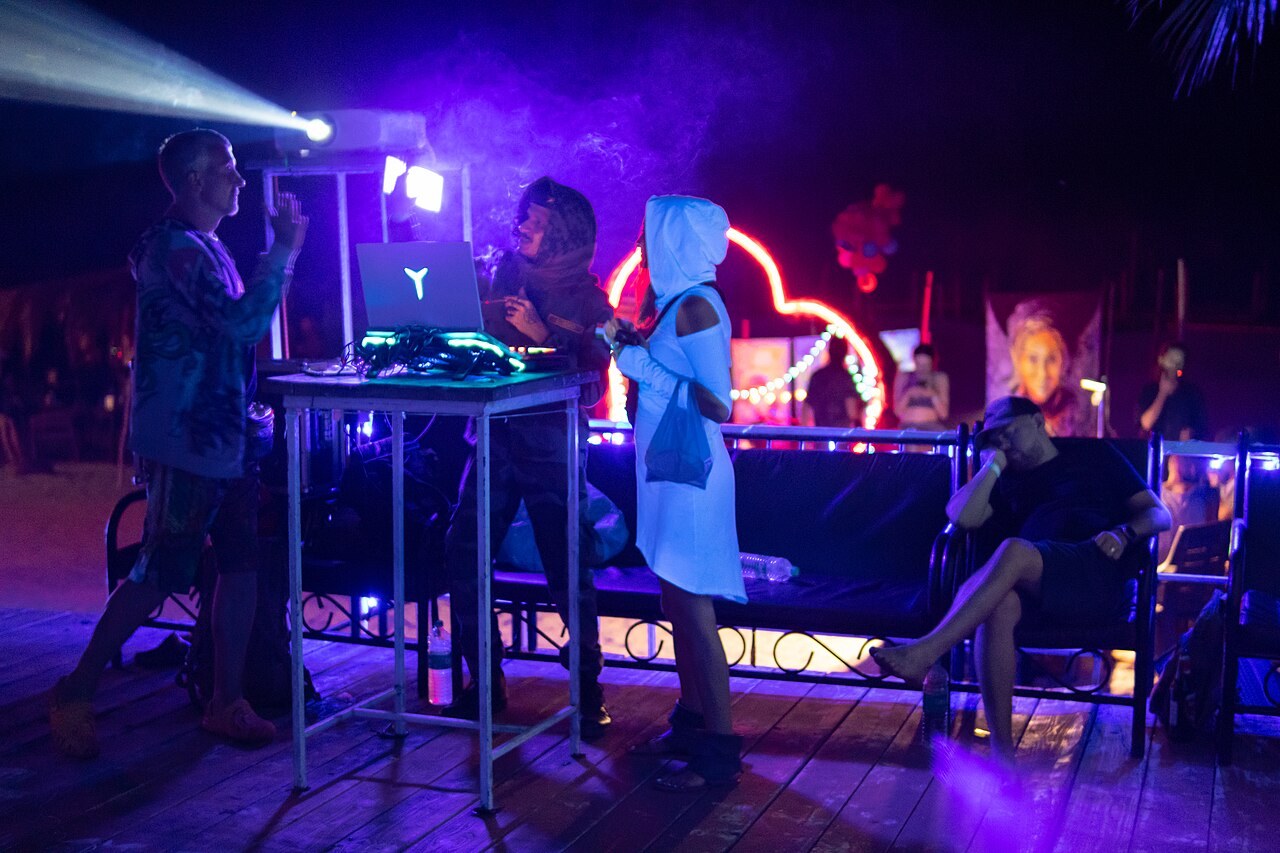
Visual art is not merely a backdrop at many psytrance events. It helps construct the temporary world in which the music is experienced. Researchers of psychedelic-trance parties describe a sensory environment in which decoration, projection, lighting, sound and landscape work together, while major festivals now commission purpose-built structures and large installation programmes.
From fluorescent décor to immersive environments
Earlier party decoration often relied on painted textiles, fluorescent and UV-reactive materials, banners and improvised shade structures. Academic descriptions of psytrance spaces repeatedly note fantastic or cosmic imagery, fauna, mandala-like forms, geometric repetition and ultraviolet colour. These elements were especially effective in dark clubs and night-time outdoor parties where black light could transform the appearance of the dancefloor.
As digital visual tools became more accessible, VJ performance, animation and projection expanded the vocabulary. Projection mapping can combine moving images with sculptural surfaces so that stage architecture itself appears to shift. The result is closer to an environment than a conventional rectangular concert screen.
Temporary architecture
Psytrance stages frequently blur the boundary between set design, sculpture and architecture. Tensile fabric, timber, bamboo, metal frameworks and modular sculptural elements can provide shade and weather protection while also shaping sightlines and movement. The dancefloor becomes a designed spatial system: entrance points, overhead forms, lighting rigs, speaker placement and decorative layers all affect how people experience the music.
Because these structures are temporary, designers also work within practical limits of transport, assembly, wind loading, fire safety, weather and dismantling. The most visually dramatic stage still has to function as event infrastructure.
Art across the festival site
The visual culture is not confined to the main dancefloor. Boom Festival’s current art programme, for example, includes large sculpture, interactive work, art gardens, water art, immersive environments, land art and digital art. Its Alchemy Circle explicitly foregrounds scenography and cinematic visuals alongside electronic music. Similar approaches can be found at other psychedelic festivals, where installations create paths, landmarks and quieter spaces away from stages.
A recurring vocabulary, not a fixed rulebook
Sacred geometry, fractals, visionary figures, alien or cosmic imagery, natural forms and hybrid technological-organic motifs recur frequently, but there is no official psytrance art style. Different festivals and crews combine local craft traditions, contemporary digital aesthetics, fantasy art, ecological design and global symbolic material in different ways.
That diversity deserves the same caution applied to music genres. A motif that appears repeatedly is not automatically universal, and religious or indigenous symbols should not be stripped of context simply because they have become familiar in psychedelic design.
Why the visuals matter
At their best, stage and installation design changes how a site is navigated and remembered. It can frame sunrise, pull attention toward or away from a DJ booth, create a shared visual focus, or turn a practical structure into a temporary landmark. Visual artists, architects, fabricators, VJs, lighting designers and installation crews therefore contribute directly to the identity of a festival.
For the wider social setting in which this work appears, see Psytrance Festival Culture and Psytrance Culture Explained.