
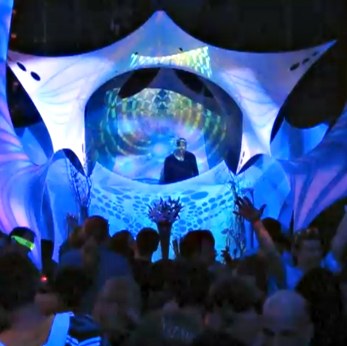
The story behind Vibrasphere
Vibrasphere was founded in Uppsala in 1998 by Rickard Berglöf and Robert Elster. Berglöf had already been involved in the Swedish Goa project Subcouds, while Elster came from his own electronic experiments, including music made on the Amiga. Together they entered the studio just as Scandinavian Psytrance was moving away from dense Goa arrangements toward a cleaner, slower and more groove-focused sound. The debut album Echo appeared in 2000 on Spiral Trax and became an early reference point for progressive psychedelic trance. Lime Structure in 2003 pushed the approach further: deep rolling bass, restrained melodic motifs, spacious production and a sense that small changes in texture could carry an entire arrangement.
Vibrasphere helped demonstrate that psychedelic music did not need constant maximal detail to remain immersive. The project’s history was not completely continuous. Robert Elster stepped away after Lime Structure during a period of heavy touring and later returned in 2005. The reunited duo produced Archipelago (2006), Exploring the Tributaries (2007) and Lungs of Life (2008). Across those records the sound widened considerably, incorporating progressive trance, house, dub, ambient and downtempo. The Selected Downbeats releases made the chill side explicit and became important in their own right. Berglöf and Elster ended Vibrasphere as an ongoing production duo around 2010–2011.
That ending should not be confused with the permanent disappearance of the name. Robert Elster later returned to performing as Vibrasphere, and 2026 bookings again presented the project as a live identity associated with him. Vibrasphere’s legacy is therefore broader than a classic progressive trance discography. The project helped create a bridge between psychedelic dance music and the more atmospheric, emotionally spacious language that later became common across progressive Psytrance and psychill.
Origins of Vibrasphere
Rickard Berglöf and Robert Elster began working together in Uppsala in 1998. Berglöf brought experience from Subcouds and the Swedish Goa scene, while Elster brought a parallel electronic-production background. Their partnership arrived at exactly the point when Scandinavia was developing a distinct progressive psychedelic sound.
The early years
Echo (2000) introduced Vibrasphere’s combination of psychedelic atmosphere and progressive restraint. Lime Structure (2003) became an even stronger genre reference, using lower-density arrangements and deep groove instead of the rapid melodic layering associated with classic Goa.
How the career developed
Elster temporarily left after Lime Structure and returned in 2005. Archipelago (2006) marked the renewed duo, followed by Exploring the Tributaries (2007) and Lungs of Life (2008). Those later albums expanded beyond Psytrance into house, ambient, dub and downtempo. The production partnership ended around 2010–2011, though Robert Elster later resumed live use of the Vibrasphere name.
Vibrasphere sound
Progressive Psytrance and progressive trance form the core, but Vibrasphere’s catalogue also contains substantial ambient, dub, downtempo and psychill material. The dance tracks are typically spacious and patient, built around deep bass, clean percussion and slowly evolving atmospheres. The chill work preserves the same sense of sonic space without the four-on-the-floor framework.
Place in psytrance history
Vibrasphere are one of the key Scandinavian projects in the emergence of Progressive Psytrance. They also helped normalize the idea that a Psytrance act could maintain an equally serious downtempo releases, making them a major bridge between progressive dance music and psychill.
Connections and influence
Subcouds connects Berglöf to the earlier Swedish Goa period. Spiral Trax is central to the project’s early rise. Later downtempo work is important enough to be treated as a parallel artistic strand, not merely bonus chill tracks attached to a trance act.
Vibrasphere today
The original Berglöf/Elster production duo ended around 2010–2011. Robert Elster has since performed again under the Vibrasphere name, with confirmed 2026 bookings, so the project is best described as legacy-active in live form rather than fully reunited.
How the sound changed over time
Selected releases in the archive
Festival connections
Ozora Festival
O.Z.O.R.A. is a Hungarian psychedelic gathering at Dádpuszta whose modern festival history began in 2004 after the site's landmark Solipse solar-eclipse celebration in 1999.
Related projects and collaborations
Artists with overlapping styles
Zen Mechanics
Dutch producer Wouter Thomassen’s progressive psychedelic-trance project, known for expansive open-air sound design and the influential 2008 album Holy Cities.
Perfect Stranger
Yuli Fershtat’s progressive psychedelic project, blending Psytrance with techno, minimal and tech-house while maintaining a strong dancefloor identity.
The Peaking Goddess Collective
Swiss four-piece live psychedelic project blending electronic production with guitar, bass, percussion and flute.
Atmos
Tomasz Balicki’s Swedish progressive Psytrance project, a foundational name in the late-1990s Scandinavian shift toward deeper, groovier trance.
Etnoscope
Etnoscope is a Swedish Progressive Psytrance group founded by Rasmus Alanne, Martin Collin and Ludvig Engelbert, noted for combining electronic trance with live tribal drumming and acoustic instrumentation.
Gaudium
Gaudium is a Swedish Progressive Psytrance project founded in 2004 by Andreas Wennersköld and Denis Bajramovski and later continued by Wennersköld as a solo-led act.